Book Review: The Art of Learning by Josh Waizkin
Half autobiography, half one badass's take on learning theory, this is a good read for coaches and students. Three stars (out of four)
Buy it here.
If you've seen or read "Searching for Bobby Fisher," the author is the subject of that film/book. The short version is that he was a chess phenom. He played world-class chess from an early age, and then his dad wrote a book about him, which then turned into a movie, which then made him more famous than was helpful for his chess career. He got to a place where he wasn't loving chess like he once did, and then discovered Tai Chi, which then led to his introduction into push hands. And after a few years of practicing push hands, he became world champion at that. World-class chess player, world-champion martial artist. Thus, badass. He said that at one point he realized that his gift wasn't that he was good at chess, and it wasn't that he was good at martial arts... he was good at learning, so he decided to write a book about it.
As I stated above, it is half autobiography... he gets a lot into his chess career and development, and into his martial arts career. These stories serve to build credibility, provide illustration for some of his points, and it's just pretty interesting to learn about his experiences. The learning theory bit is good stuff. Nothing revolutionary, but I think that his stories really help illustrate his point. The basic idea of his theory (condensed to my take) is:
- Deconstruct the thing you are trying to learn (e.g., if you are trying to learn Judo, you may think of it consisting of skills such as gripping, using footwork to neutralize Kuzushi, disrupting the advancing foot, etc)
- Focus down on one thing at a time, building from the ground up, and perfect and internalize that thing (e.g., spend time practicing Tsugiashi movement, then practice Tsugiashi while connected to a moving partner... then connected to an attacking partner, finding and fixing gaps and mistakes, until you are unconsciously maintaining a solid, mobile base wherever circumstances lead you)
- As you internalize more and more of the base skills, time will "slow down" as your conscious mind can focus on less and less, and you can "specialize" the skills which you are seeking to learn
- During this process, you will need to "invest in loss" - in part, that means not being afraid to lose as you are working on a new skill; in part, it means that you should seek out those who can beat you so that you can find new areas to develop in your game
- There is also quite a bit on psychology... both how to "get in your opponent's head" as well as how to trigger optimum performance states in your own mind
Nage no Kata Attacks - Uke Gets ... No Smarter?: The Sumo Shuffle
... Umm... I got nothing. And I don't like it.
As I mentioned in this post, I have a hypothesis that there was some reason for Tori to select the throw she does... some reason more meaningful than "Tori really wanted to do Uki Goshi." So, in these posts, I explored the subtle differences in Uke's actions which trigger specific throws, and I am pretty satisfied with the answers.
As I was performing the Kata the other day, however, I couldn't discern any difference between what Uke was supposed to be doing during the "Jigotai Shuffles" in Sumi Gaeshi vs. Uki Waza. So I started reading. I have a few books by people who know a lot more about Kata than I do, and thus far, I have been really happy that these books have been able to answer the questions I have had. Not so here. In Formal Techniques, Draeger mentions no difference. In fact, he says a few times that Uke and Tori are repeating themselves in Uki Waza. Same thing in Leggett's book. Same in Kawaishi's.
So... is my hypothesis wrong? (I already know your answer, LEO!) Or, is there some difference that these clowns didn't pick up on? What do you think? Do any of you guys do anything differently to induce Uki Waza instead of another Sumi Gaeshi?
The Gokyo - Kodokan vs. Mifune
Mifune was a wizard, and evidently a rebel. He was the Harry Potter of Judo?
Did you guys know that Mifune had his own Gokyo (well... you would if you had read my review of his Canon of Judo). Some interesting differences... I don't have a ton of insight here just yet, but figured I would post this for those who are interested. At some point I will post my color-coded Excel file which makes comparison between the two a bit easier.| # | Kodokan | Mifune |
| 1-1 | Deashi Barai | Deashi Barai |
| 1-2 | Hiza Guruma | Hiza Guruma |
| 1-3 | Sasae Tsurikomi Ashi | Uki Goshi |
| 1-4 | Uki Goshi | Sasae Tsurikomi Ashi |
| 1-5 | Ogoshi | Osoto Gari |
| 1-6 | Osoto Gari | Tsuri Goshi |
| 1-7 | Ouchi Gari | Tai Otoshi |
| 1-8 | Seoi Nage | Tsurikomi Goshi |
| 2-1 | Kosoto Gari | Kouchi Gari |
| 2-2 | Kouchi Gari | Koshi Guruma |
| 2-3 | Koshi Guruma | Kosoto Gari |
| 2-4 | Tsurikomi Goshi | Ogoshi |
| 2-5 | Okuriashi Barai | Seoi Nage |
| 2-6 | Tai Otoshi | Ouchi Gari |
| 2-7 | Harai Goshi | Kosoto Gake |
| 2-8 | Uchi Mata | Harai Goshi |
| 3-1 | Kosoto Gake | Uchi Mata |
| 3-2 | Tsuri Goshi | Hane Goshi |
| 3-3 | Yoko Otoshi | Hane Makikomi |
| 3-4 | Ashi Guruma | Harai Tsurikomi Ashi |
| 3-5 | Hane Goshi | Tomoe Nage |
| 3-6 | Harai Tsurikomi Ashi | Sukui Nage |
| 3-7 | Tomoe Nage | Ashi Guruma |
| 3-8 | Kata Guruma | Ushiro Goshi |
| 4-1 | Sumi Gaeshi | Yoko Guruma |
| 4-2 | Tani Otoshi | Osoto Guruma |
| 4-3 | Hane Makikomi | Uki Otoshi |
| 4-4 | Sukui Nage | Utsuri Goshi |
| 4-5 | Utsuri Goshi | Uki Waza |
| 4-6 | O Guruma | Tani Otoshi |
| 4-7 | Soto Makikomi | Yoko Otoshi |
| 4-8 | Uki Otoshi | Yoko Gake |
| 5-1 | Osoto Guruma | Ura Nage |
| 5-2 | Uki Waza | Sumi Otoshi |
| 5-3 | Yoko Wakare | Yoko Wakare |
| 5-4 | Yoko Guruma | O Guruma |
| 5-5 | Ushiro Goshi | Okuriashi Barai |
| 5-6 | Ura Nage | Sumi Gaeshi |
| 5-7 | Sumi Otoshi | Kata Guruma |
| 5-8 | Yoko Gake | Soto Makikomi |
Book Review: Judo Formal Techniques by Tadao Otaki and Donn Draeger
It's not exactly light summer reading, but but if you want to learn Nage no Kata or Katame no Kata, this is your book. Three stars (out of four)
Buy it here.
The Upshot:
Everything you ever wanted to know about the Randori no Kata (Nage no Kata and Katame no Kata). It gives you the details for Uke and Tori in an easy-to-follow manner. And when I say that it gives you the details, it even covers how to sit up after you are thrown. 450 pages, over 1,000 illustrations... lots of detail. Not one that you will want to read cover-to-cover (God help you), but if you want to investigate a particular technique, you'll almost assuredly find what you need in here.
What's In It, and How It's Organized:
- Historical Background
- Outline of Judo Kata - A very brief overview of the official Kodokan Kata as well as a mention of the unofficial Kata
- Understanding Kata - Making the case for studying Kata
- Famous Japanese Judoists on Kata - Other people making the case for studying Kata
- Kata Fundamentals - Notes about things like mindset, breathing, and adjusting the gi... general aspects that don't apply specifically to one Kata or the other
- Technical Aspects of Nage no Kata - Think of this as general tips specific to Nage no Kata
- Technical Aspects of Katame no Kata
- Nage no Kata - The nitty-gritty
- Katame no Kata
- The Study and Practice of Kata - How to make the most of Kata training
Could Have Been Better:
One thing I would have liked to have seen is more on the historical development of these Kata - how they changed and evolved over the years, what different variants were popular, etc. Otaki and Draeger definitely present this as "the one true way" with little tolerance for variation, which seems stifling to me... That said, they do advocate variation in some of the non-technical chapters. The layout of the chapters was a bit odd (e.g., why not put "Technical Aspects of Nage no Kata" next to the "Nage no Kata" chapter), but given that this is more of a reference book than one you would read front-to-back, that doesn't detract too much.
One Thing I Learned:
Nage no Kata. But seriously, folks... I already wrote about it here, but the most important thing I learned recently was the differences between the various incarnations of the 3-push attacks. The 3-pushes never made sense to me before, because I couldn't figure out why Tori was doing Kata Guruma instead of another Uki Otoshi. The explanations in "Formal Techniques" (largely contained in one brief section where he reviews the differences) helped the 3-push attacks fit in with my conception of what Kata was supposed to be.
If you are just learning the Kata, you probably don't need this book. If you think Kata is a complete waste of time, and nobody can persuade you otherwise, you can do without this book. If you just need to be able to make it look good enough for rank examinations, skip it. But if you are curious about Kata in general or Nage/Katame no Kata in specific, if you want to figure out how to make Kata a useful tool in your training repertoire, or you are in a serious study of Nage no Kata, you should get the book. There is not - and has not been - any book in English that even comes close (I don't know about other languages).
A Note for Akari Judo Students re: Nage no Kata: I've Been Doing it Wrong
Umm... It takes a big man to admit when he's wrong? Well, I think Nage no Kata will give me plenty of chances to demonstrate my bigness.
So... quick note here for anyone who has learned Nage no Kata from me: I have been teaching (and executing) both the 3-push and head bash attacks wrong, for the most part.
For the 3-push, the main culprit, as I mentioned in my discussion of the variations in the 3-push attack, is that I only recently put together the fact that there are actually supposed to be any differences in this attack. So when I taught it before, all 6 of my 3-pushes were the same - and it was just on Tori to choose a different attack. This was wrong. Oh, and in addition to the differences that I mentioned, Uke isn't really supposed to nail the heel/toe foot spacing. I think he tries, but Tori's actions screw him up, such that the trailing foot is sometimes further back.
For the head bash, my second step has been too big on all but the Yoko Guruma attack... Uke is supposed to strike with his feet almost at heel/toe, rather than at the end of a giant stride. The first step is still big, but the second step is usually smaller. This, of course, means that you must set up closer to Tori than you are used to (provided that you are used to doing it the way I do it). I've known about the differences in this attack, but I didn't realize that my foot spacing had been wrong. I think this adjustment will make the first 3 muuuch easier.
I realized this as I went through my source materials to research these posts... Looking at the pictures, better understanding Uke's adjustments and mindset... yeah... I've been doing it wrong. Whoops.
So here's what I need from you, Akari Judoka: Help me. I will forget. I will go back to the way I have trained it for the last 20 years. Keep an eye on me, and call me out when I do it my old, wrong way. Then we can all get better!
Thanks!
Nage no Kata Attacks - Uke Gets Smarter #2: The Head Bash
Uke gets smarter... but he never quite gets smart enough to realize that tennis-serving someone's head is not the most effective assault.
Continuing from my last post, in which I discuss subtle variations in the 6 incarnations of the 3-push, I'll now turn my attention to the next most frequent attack: The "Head Bash." You know, that great big silly-looking overhead smash of Uke's head... Just like in the 3-push, each manifestation of the head bash will be different than the one before it, based on what Uke learned in his previous encounter.
- Ippon Seoi Nage: Similar to the first 3-push, this is a totally reckless attack, where Uke is trying to knock Tori's head into her torso, and has no regard for his balance, extension, and general vulerability. He puts his whole body into the attack.
- Uki Goshi: Now, Uke realizes that he was overcommitted to the attack, and holds back. He better balances his weight on each foot, and straightens up some (as opposed to bending during the prior attack) to stifle any incoming Seoi Nage. He also posts his left hand to check Tori's hips, should she try to blast him with Seoi again. All of this sets up Uki Goshi quite nicely.
- Ura Nage: Now Uke has modified his prior thinking. He still doesn't want to destroy his balance (as in Seoi), but stiffening up wasn't a good idea (as in Uki Goshi). Now, he sinks his weight a bit, and adds his heavy follow through back in. And gets blasted with Ura Nage.
- Yoko Guruma: To thwart the Ura Nage, as well as the Seoi and Uki Goshi, Uke now lengthens his base (basically taking a larger second step towards Tori). Tori, in one of his most oblivious moments of the whole Kata, doesn't pick up on the change and attempts another Ura Nage. Uke then responds to the Ura by headlocking Tori and shoving her head down at ~90 degrees to the original attack. This gives Tori the perfect setup for the Yoko Guruma.
Nage no Kata Attacks - Uke Gets Smarter #1: The 3-Push
Uke gets smarter... but he never quite gets smart enough to stop attacking someone who clearly outclasses him.
As I mentioned in my Nage no Kata overview, Uke may repeat the same type of attack (e.g., the 3-push), but he's going to change the specifics of those attacks to address the gaps that got him thrown the last time he tried it. It is these subtle changes, then, that cause Tori to utilize a different throw than the one she tried before. See below for examples of what I'm talking about. Before you do that, though, note that this is based a little bit on instruction, a lot on Otaki/Draeger's Formal Techniques, a little on Legget's Demonstration of Throws, and a bit of educated guess. Add to that that I only recently gathered all of this together, so I'm not even close to having the execution down. Which is to say that you should take this interpretation with a grain of salt.
With those caveats, here's my understanding of how the 3 push attacks change.
- Uki Otoshi: "Unhesitating" advance. Uke is putting everything into it, not giving much thought to consequences.
- Kata Guruma: Uke braces with the lead foot to avoid being over-extended - this presents a target for Tori's Kata Guruma. Additionally, Uke tries to have a more relaxed body during the push. Tori feels this and changes the grip to freak Uke out a bit and to cause him to stiffen up.
- Harai Goshi: Uke does a better job of blending with Tori, again seeking to relax, and is thinking to walk around a Kata Guruma attempt, so Tori changes his grip (hand behind the armpit), which then causes Uke to stiffen and helps the Kuzushi. The Harai action, in combination with Tori's pull, is a response to Uke's attempt to go off-line.
- Tsurikomi Goshi: Uke hangs back a bit to avoid Harai *and* keeps his elbow in (thus preventing the previous grip change). Tori's initial grip change (to the high lapel) freaks Uke out a little (and causes some stiffening), and then Tori feints a "normal height" hip throw to trigger an "extreme stiffening" in Uke (an attempted hip check, basically), and immediately drops the bottom out with Tsuri Komi Goshi.
- Sasae Tsurikomi Ashi: Uke does a great job blending with Tori... until the Tori's "J-step" (the long withdrawal of her lead foot past her rear foot and out to the side; the step that immediately precedes the lifting of her propping foot), and that causes Uke - once again - to freak out a bit, stiffen up, and allow Tori's additional retreat to unbalance him.
- Yoko Gake: Uke again does a great job of blending with Tori, so Tori starts to turn Uke by ratcheting in the elbow. This screws with Uke's ability to maintain the excellent blending. Then Uke gets blasted with Yoko Gake. Poor devil.
Nage no Kata - The Overview
My next several posts are going to be about Nage no Kata, so I figured I would give a brief primer on it first...
Nage no Kata - "Forms of Throwing"
This Kata has 5 sets (one for each class of throw) containing 3 throws each, aimed at demonstrating the breadth of throwing techniques found in Judo. In my opinion, there are 3 main aims of this Kata:
- To promote practice, investigation, and eventually mastery of the breadth of standing techniques
- To instill "automatic" responses to broadly different types of attack movements (e.g., pushes, head bops, etc); this is hard
- Building on #2, to instill a natural sensitivity in Tori to discern subtle differences between otherwise similar attacks (e.g., a "reckless" push vs. a "halting" push), and to "automate" an appropriate response to these different attacks; this one is really hard
- Te Waza (Hand Techniques)
- Uki Otoshi
- Ippon Seoi Nage
- Kata Guruma
- Koshi Waza (Hip Techniques)
- Uki Goshi
- Harai Goshi
- Tsurikomi Goshi
- Ashi Waza (Foot/Leg Techniques)
- Okuriashi Barai
- Sasae Tsurikomi Ashi
- Uchi Mata
- Ma Sutemi Waza (Back Sacrifice Techniques)
- Tomoe Nage
- Ura Nage
- Sumi Gaeshi
- Yoko Sutemi Waza (Side Sacrifice Techniques)
- Yoko Gake
- Yoko Guruma
- Uki Waza
- Push to the rear, a.k.a., the "Three Push" - 8 (ish) versions... 6 for sure, resulting in: Uki Otoshi, Kata Guruma, Harai Goshi, Tsurkomi Goshi, Sasae Tsurikomi Ashi, Yoko Gake
- The "ish" part is because in Uchi Mata and Tomoe Nage, I believe Uke is intending to initiate a 3 push, but never really gets started; Tori steals the initiative.
- Head smash, a.k.a, the "Bunny Foofoo" - 4 versions, resulting in: Ippon Seoi Nage, Uki Goshi, Ura Nage, Yoko Guruma
- Sideways drag - 1 version, resulting in: Okuriashi Barai
- Jigotai grab, a.k.a, the "Sumo Shuffle" - 2 versions, resulting in: Sumi Gaeshi, Uki Waza
- This one kind of stretches the concept of Uke "attacking" but you can think of this one as another instance of Tori "stealing the initiative"
Judo Formal Techniques: A Complete Guide to Kodokan Randori no Kata
Nage no Kata Fun Facts:
- This is one of the two "Randori no Kata;" the other is Katame no Kata (Forms of Grappling)
- Kano included Kata Guruma as the final piece of Nage no Kata in it's present form; it displaced Sukui Nage from a previous version
- As a result, Uke never does a back breakfall in this Kata
- *I believe* this is the only Kata that demonstrates each technique both right- and left-sided
In Kata, Uke is in the Driver's Seat
Ever notice in the old pictures and videos of people doing Kata, Uke is often has the higher rank... Ever wonder why that is? Part of it is because Uke has a harder job than Tori...
- ... create the right circumstances for Tori to execute the desired technique(s). Uke dictates what throw is to be done by his movement and the other specifics of his attack. Tori just has to recognize what Uke is "telling" her to do (via his attack), and then do it. This is really really hard when you get into the finer distinctions... So hard that I've not yet done it right (even approaching right) for an entire kata. (I'll post more about this in Nage no Kata later)
- ... set the right spacing between partners. This is really just a part of creating the right circumstances, but I'm calling it out separately because it happens "in-between" techniques. In most Kata, Tori just picks a spot on the mat, and Uke then picks the best point from which to launch his attack. Uke adjusts to Tori, not the other way around. As a side note, if you are my Tori in a Kata practice, STOP MOVING! I'm setting the distance I want, so when you inch towards me, I need to inch back. =:>
- ... remember the order in which the techniques are to be performed. By setting the spacing and generally moving first, and otherwise creating the right situation for the throw, Uke is really on the hook for remembering the order. In advanced Nage no Kata practice, Uke can intentionally screw up the order of techniques as a check on whether Tori is properly tuned in.
- ... set the pace at which the Kata is to be performed. If Uke goes fast, then Tori must go fast. If Uke goes slow, then Tori should go slow.
- ... set the mood. No, not cranking up the Teddy Pendergrass and lighting candles. I'm talking about creating the right frame of mind for the practice. Focus, intensity, even the underlying intentions... Sure, Uke is pushing Tori, but what is he trying to accomplish with this push? This is really another sub-set of creating the right circumstances, but I wanted to call it out.
Oh Boy! MORE NEW RULES!
Randori vs. Shiai
It's kind of like the difference between learning to walk and being chased by a mean dog.
According to Dr. Kano, there are three tools for instruction or practice: Kata, Randori, and Shiai. At the highest level, here's what they mean:
• Kata: practice of forms; predetermined movements
• Randori: adversarial, free-moving practice
• Shiai: competition, tournament (I've posted before about the value of competition.)
I'm not going to talk about Kata here (though it bears discussion), but I do want to talk about the difference between Shiai and Randori because they're sometimes confused.
Randori is practice. To "win" in Randori, you just need to learn something new or get better or help your partner learn. Thus, you can still win if you get thrown 30 times. The way you "lose" in Randori is that you don't do any of those things and/or you hurt yourself. You are generally not putting your heart and soul into putting your partners back on the mat. Given the principle of "Jita Kyoei” (mutual benefit), you are trying both to help yourself as well as help your partner. That doesn't mean that there's no struggle, but it does mean that if a 200 pound black belt is going against a 150 pound green belt, the 200 pounder shouldn't be making it as difficult for the green belt as he is capable. Maybe the 200 pounder will decide to focus more on foot sweeps, or he will give the green belt many looks at the same attack (even if that attack puts the green belt on his butt every time)…
Shiai, on the other hand, is a competition. You “win” in competition by winning. You put the other guy on his back, you pin him, you make him tap, you get more points, or he gets disqualified (though I'm not a fan of people who try to get the other guy disqualified). If, for whatever reason, the 200 pounder in the 150 pounder mentioned above were in the same division, and they found themselves facing off against each other, the 200 pounder's job is to put the smaller man on his back with force and control. As I mentioned in the article I linked to above, both Randori and Shiai are about field testing your Judo. Shiai, though, is intended to be a more extreme environment, where the other guy is trying as hard as he can to put you on your back, and you’re seeing how your Judo works in that situation. Jita Kyoei still applies, but in this instance the benefit that you are providing your opponent is a sincere attack.
Randori has partners, Shiai has opponents.
One's first Shiai is often an eye-opening experience. You get hit. You get ground up. You get mauled. You get jostled like you've never been jostled before. It may not be beautiful judo, but that isn't to say that that's not what your opponent is supposed to be doing. You see, they're giving you the opportunity to test your judo against somebody who's mauling, hitting, and jostling you. That's a useful skill. Just be ready for it.
And if they're doing that in Randori, tell them to knock it off.
I'm Back! And I Bring a New Syllabus!
I've gone a while due to a whole
bunch of reasons (including another beautiful baby!), but now I'm back. And I
have a new syllabus for Akari Judo!
It's been a while. Been a while since I've made a blog post,
been a while since I've updated my syllabus. Well, that changes today. For the
first time in three years and got an update to my syllabus and I think you guys
will like it. Working with Leo Valdes and Jacob Powell. We synchronized and
simplified our syllabi… Well, I simplified mine; theirs were already simple. I
got rid of a bunch of stuff that I copied from USJA syllabus – things like
moving skills, rollovers, and sweeps. It's not that I don't care about that
stuff anymore, it's just that we're not going to be testing for it. Take a look
and let me know what you think.
Olympic Judo Media Coverage
Every four years, our beloved art gets a few minutes of media coverage. Was it just the perfect storm that this year, most of the coverage was terrible?
So, if any of you have been on the look-out, you've seen lots more Judo coverage than normal in the American press - or, said differently, you've seen *some* coverage of Judo in the American press, which is lots more than normal... What are the stories that you would have seen?
Wodjan Shaherkhani - A great story about the first Saudi woman to ever compete in the Olympics. Of course, the assholes in the IJF being assholes, they didn't want to let a good story about judo get out.. they required some IOC arm-twisting before they would let her compete while wearing her Hijab. This despite the fact that there are numerous tournaments in Asia which allow the Hijab to be worn. Pricks.
Nick Delpopolo - Played well for team USA. Seemed very relaxed. And inexplicably hungry. Because he ate a pot brownie. Are you F*$king kidding me? The OLYMPICS! AND YOU EAT A POT BROWNIE?!?!
Kayla Harrison - She won gold, steamrolled some world-class athletes, and was frigging awesome. Of course pretty much every article that highlighted her win also highlighted the sexual abuse she suffered at the hands of her coach. That piece of shit.
As a side note - Sheryl Swoopes - not a Judoka; rather, the former WNBA player - is the the definition of vapid, referring to sexual abuse as "things not going your way": http://www.shape.com/blogs/london-2012-summer-olympics/kayla-harrisons-journey-ends-gold-medal - Again: Are you F*$king kidding me?
Book Review: Juji Gatame Encyclopedia by Steve Scott
Steve Scott again shows his talent for naming books (and writing them) in this phenomenal work that includes more mentions of the word "crotch" than you're likely to find anywhere else. Four Stars (out of Four)
Juji Gatame Encyclopedia
The Upshot:
As I mentioned in a previous post, this is what the Judo Masterclass books should be. It contains a wealth of knowledge with a narrow focus. He categorizes different types of Juji Gatame (spinning, head roll, hip roll, back roll, and belly down/miscellaneous), and then looks at several variations of each. He also considers transitions/combinations, defenses, and tips on levering your opponent's arm. Additionally, lots of great drill ideas are provided. There are 422 pages in this tome, with plenty of pictures and helpful descriptions. This is a must-have book that is bound to show even the most experienced player one or two new entries (or one or two hundred), and will open players' minds to the world of possibilities in Juji Gatame. I was about 10% of the way through this book when I felt that I had gotten my money's worth*, and things just got better from there.
What's In It, and How It's Organized:
- Introduction
- Drills
- Core Skills: Examines some skills that are common to almost all Juji Gatame applications
- Four Basic Entries: Introduces the spinning Juji, the head roll Juji, the back roll Juji, and the hip roll Juji
- Spinning Juji Gatame
- Back roll Juji Gatame
- Head roll Juji Gatame
- Hip roll Juji Gatame
- Traps and levers
- Juji Gatame combinations
- Transitions
- Belly down and other miscellaneous Juji's
- Defense and escapes
Could Have Been Better:
The biggest complaint I have with this book is that while it shows a million variations, it often fails to provide a good explanation of why you should do that particular variation. That is, what is the opponent doing differently that makes you choose one version over the other? And a small matter of personal preference, but I like the pictures to be shown in a series together with the accompanying text grouped together, as in Kodakan Judo Throwing Techniques. Some of the picture sequences are disjointed, or the description doesn't match the picture, but this is pretty rare.
One Thing I Learned:
There were tons of new techniques in here that I had not thought about before – as well as improvements to techniques I already knew – but one that I liked in particular was the "Henges Hanger;" basically a way to choke your opponent while you wait to arm bar them. It's a bit lengthy to explain in detail without pictures, but the upshot is that you figure four the arm that you're trying to lever loose, and then use that to choke your opponent.
While you could certainly go your entire Judo career without ever applying Juji Gatame, that would be an absolute shame. And if you want to get better at Juji Gatame, then this book really is a must-have. And let's hope that Sensei Scott continues to make more books like this.
* Full disclosure: Mr. Scott actually provided the copy that I reviewed, so, when I mention getting my money's worth, I mean I felt like I had gotten enough value out of the book to warrant the purchase price. =:>
Final Thoughts on the Olympics
- Marti Malloy was phenomenal, but boy did she ever get screwed.
- She threw her Russian opponent twice for Ippons that would later be waved off. And I have no idea how the first one turned in to a Yuko: the center judge called Ippon, and the corner judge that was in view of the camera called a Waza Ari. So, even if the other corner judge called no score (which would have been ridiculous), that should have come out to be a Waza Ari, minimum.
- Against her Hungarian opponent, I think the Hungarian went for full 4 min. and 50 seconds without making a throw attempt. How she didn't get penalized is beyond me.
- Shaherkani was able to become the first Saudi woman to ever compete in the Olympics. The assholes in charge of the IJF tried to prevent her from competing with a hijab (head covering), but I suspect the IOC twisted their arms until they changed their mind. Here are some fun facts about Shaherkani: she's 16 and she's not a black belt. That one kind of makes you wonder: issue one of the best female athletes said Saudi Arabia had to offer up, or were they trying to set something else up to show why they shouldn't send women into the Olympics? Anyhoo, she didn't win, but good for her for showing up.
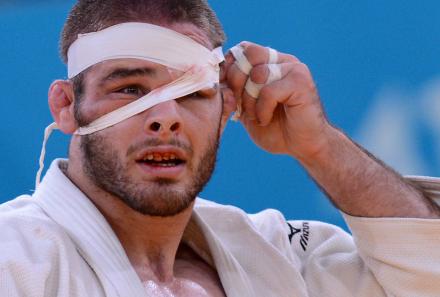
Travis Stevens' semifinal match against Bischoff was ridiculous... He got a small mouse right at the beginning, so they wrapped tape around his head a few times, partially obscuring his vision. Then he got a scratch on the bridge of his nose, so they wrapped another piece of tape around his head a few more times, further obscuring his vision out of that left eye. And now he looks like a mummy. Later in the match, I think he got poked in his one good eye.
- That match got testy (teste?), too. I've never seen a ref demand that players shake hands in the middle of a match.
- Of course, this wasn't the worst tape job of the day: Ugo Legrande had a strip going in between his nose and his lip.

- American fans really showed up in this games. There seem to a been a ton of fans there.
- What's even better, the American team really showed up this year. Our first gold ever, a bronze, and two semifinal appearances. That's phenomenal. A lot of respect is due to our athletes and to Coach Jimmy Pedro, Jr. for their great work over the last several years.
- The Japanese, on the other hand, seem to be on the way down. Seven medals, with only one gold – and no golds for the men. Of course, they had more medals than we had participants, but it's not good by their standards.
- There were a ton of examples of bad refereeing in this Olympics, but the example that stands out most to me is this one: Nakai of Japan was thrown for Waza Ari with only the bottom of his butt touching the mat, as he rolled over his opponent (his opponent precluding even a possibility that his back could have touched the mat). What the hell?
- I have grown to really hate the music that they play at the start and end of all the matches.
- Was I just taught the wrong thing when I took my reffing class? nine times out of 10 when there's a score change, the match is stopped and referees conference. I thought that when there is a difference of opinion over the score, the procedure was supposed to go like this:
- Corner judges were to signal their desired score from a seated position.
- In the event that they both showed the same score, they would stand up to signal to the center referee that they agreed.
- in the event that they disagreed, they would effectively average the score between their respective scores and the center ref's score, and then rise signalling that average (unless the average was the same as the center ref's original score).
- For example, the center ref signals an Ippon, and the two corner refs think it was a Waza Ari. They signal Waza Ari and stand to let the center ref know that they agree.
- The center ref signals an Ippon, one corner ref signals a Waza Ari, the other corner of signals a Yuko. The judges average their score to a Waza Ari, and stand to signal this to the ref.
- The center ref signals a Waza Ari, one corner of signals an Ippon, and the other corner ref signals aYuko. Since the average is a Waza Ari (the center ref's score), the corner judges drop their signals and do nothing else.
- When the center ref sees that he's been overruled by the standing corner judges, he waves off his original score and signals the new score that the corner judges show.
Quick Thoughts on the Olympics, Thus Far (Round 3 - Kayla Harrison Edition!)
- Finally! Ne Waza! Our girl Kayla Harrison rocked a nice Juji Gatame against her first round Russian opponent, and finished of her Brazilian semifinal opponent with a weird Juji Gatame from the bottom! And I saw one of the 100kg men (Mongolia's Naidan, perhaps?) *actually pull his leg out of half-guard* to secure a pin! Miracles!
- Hungary's Abigel Joo evidently injured herself to the point where she was barely walking towards the end her quarterfinal loss against the US's Kayla Harrison. She toughed through it, and hobbled to the repechage round... Evidently, she just needed to walk it off a bit, because she started moving better with about 30 seconds left, and pulled off a BEAUTIFUL cartwheeling Uchi Mata. Phat.
- As a side note, I thought coach Pedro handled the situation well when Joo was injured. Instead of saying "SHE'S HURT! MOVE IN FOR THE KILL!", he simply yelled "LOOK AT HER!" to make sure that Harrison noted the situation.
- Finally saw a split decision in the women's 78kg repechage. And, in this one, everyone raised their flag at the same time.
- Maybe it's just been my luck, but NBC seems to have fixed their randomly-timed commercial breaks during streaming
- The German coach is doing alright for himself... He carried Dimitri Peters off after winning the bronze, and Peters is one big Gerry...
- Another thing that cracks me up is how athletes will look expectantly at a ref after throwing (instead of locking down their opponent) - our own Kayla Harrison did it in the finals... Does that mean that I shouldn't get so upset with our juniors when they do it?
- Anybody else notice that Neil Adams (who had been announcing the contestants and the winners to the crowd) didn't have the mic to announce Harrison's victory? Conspiracy!
- WAY TO EFFING GO KAYLA! YOU WERE PHENOMENAL! You won, and you won in style, really dominating your opponents and demonstrating some great Judo in the process!
Quick Thoughts on the Olympics, Thus Far (Round 2)
- From what I've watched, the Georgians seem to be doing the best Judo... Lots of great attacks. What do you guys think?
Anybody know what happened to 52kg Italian bronze-medalist Forciniti's hand? I don't think it was broken, but I've never seen a wrap like that in a Judo... - Is it just me, or is it weird seeing the Cuban women's coach in a suit? I'm used to seeing him engulfing a folding chair wearing his sweats. Definitely an upgrade.
- Funny to see that even the best in the world screw up bowing in and bowing out. Public Service Announcement: You stand in front of the mark while you wait for the match to be awarded.
- The judges' decisions (when they raise their flags at the end to determine a winner) seem suspect. I haven't yet seen one that isn't unanimous (which seems improbable), and there always seems to be a lag between the first and last flags are raised - as if a judge were waiting to see how the other judges ruled before raising his own flag... Anyone else notice this?
- The refs made it up to Korea's Jun-Ho for screwing him the other day by selecting him as the winner of the bronze medal match against the Spaniard
With the exception of 2 or 3 individuals, I haven't seen anyone even *try* to do groundwork, unless they accidentally had to. Bah.- Any Judoka/Statisticians (Ann Maria De Mars?), if you're out there: In case you are running out of ways to fill your spare time, here's an analysis I'd love to see - What is the best predictor of judges' decision - is it just attack frequency? Is there a recency bias?
A Judo Spectator's Guide - Just in Time for the Olympics!
So you've come across the Judo footage, but you're having a hard time following what's happening? This is the place for you.
There are a ton of rules and nuances (largely inane) in Judo, so think of this as a high-level guide. If you see something that doesn't fit with this guide, it probably has to do with one of those nuances. I'm not a rules expert, but if you have a question, feel free to leave a comment and I will answer as best I can.
How do you score?
There are 4 ways to score in Judo:
- You throw your opponent
- You pin your opponent mostly on their back
- You make your opponent submit (typically by tapping), due to either arm-bar, or strangulation
- Your opponent accumulates penalties
- Ippon: Instant win - the ref will hold one arm straight over his head. You get this for:
- Throwing your opponent with power and control, usually on their back
- Pinning your opponent largely on their back for 25 seconds
- Making your opponent submit, either due to arm-bar or choke
- Your opponent accumulating too many penalties, or getting a severe penalty
- Waza Ari: Get 2 of these, and you win - the ref will hold his arm straight out to the side. You get a Waza Ari when the throw isn't quite as good, the pin is at least 20 seconds, or the opponent accumulates just 3 penalties.
- Yuko: Think of this as a tie-breaker point; no number of Yukos is as good as a single Waza Ari - the ref will hold his arm at a downward angle to the side. The throws will typically land the opponent on their side instead of their back, the hold-downs are between 15-20 seconds, and only 2 penalties are needed for a Yuko.
- A throw that lands the opponent belly-down, on their butt, or their head, or anything other than their side or their back
- A pin that doesn't last at least 15 seconds, or where the person being pinned has their legs wrapped around the opponent's body or leg (guard or half-guard)
- You also get no credit for passing guard, taking their back, sweeping, or anything else on the ground that isn't a pin
How do you win?
- Get an Ippon
- Get 2 Waza Aris
- Your opponent gets 4 minor or 1 severe penalty
- You have a greater score than your opponent at the end of regulation time
- Your opponent withdraws or can't continue
- Get any score during the "golden score" period (see below)
- The judges pick you as the winner if time runs out in the "golden score" period
What exactly is "Golden Score"?
"Golden Score" is basically overtime for Judo. If there is no winner at the end of regulation time (5 minutes for men, 4 for women), then it goes into a 3 minute sudden death, where any score for any reason wins.
Soooo... what's with the penalties? - or, What's with those yellow squares?
There are way too many things that get you penalized in Judo. I won't go over them here, but the most common two that you will see are going too long without attacking (the ref rolls his arms like a "travelling" gesture in basketball), or for making garbage attacks that are generally aimed at killing time or trying to get to the ground (the ref makes a downward tugging motion with his arms).
Whatever the penalty, the ref will stop the action, make some gesture (like one of the two mentioned above) at one of the contestants, and then point at that contestant.
- When one contestant is penalized, the first one will be a warning (unless it's a severe penalty, in which case she'll just get thrown out), and you'll see a yellow box show up next to their name on-screen in NBC's coverage (actually, it'll be next to a white or blue box, which just denotes what color gi the contestant is wearing).
- The second penalty (two yellow boxes) awards a Yuko.
- Things get a little weird at the third penalty: the Yuko is removed, and a Waza Ari is added to the opponent's score, and three yellow boxes are shown. And if the opponent already had a Waza Ari, then the match is over (2 Waza Aris = win).
- The fourth penalty removes the Waza Ari, and the contestant is disqualified.
How do you medal? - or, What's with the two bronze medals? - or, What the heck is "Repechage"?
Repechage is the French word for loser's bracket. Not really, but you can think of it that way. Basically, what happens is this: repechage begins with two matches consisting of the four losers from the quarterfinal round. The winners of each match will go on play a loser from one of the two semifinal matches. The two winners of these matches, then, are awarded a bronze medal and their day is done. The winners of the semifinals compete in the finals (of course): the winner gets gold and loser gets silver.
Hopefully this will be helpful.
Quick Thoughts on the Olympics, Thus Far (Round 1)
I haven't watched all of the divisions, but wanted to offer some commentary on what I have seen, so far:
- Wow... the 60 kg Frenchman Milous was really given a gift against his Georgian opponent: Down a yuko with 30 seconds left, he was thrown for no score with only his Frenchness preventing the Ippon (the Georgian was ROBBED). With JUST 5 SECONDS on the board, Milous destroyed the guy with an ippon.
Sigauque (right) from Mozambique is 27, though this dude looks like a teenager.- Watching this stuff without Neil Adams doing the commentary just isn't the same... I just want someone to yell "ROIGHT THE WAY OVA!" or "HE SWITCHED IT!"
- Also, the randomly-timed advertisements on NBC.com's streaming are ANNOYING. Couldn't they find an intern somewhere to put in queues for commercials during the "Matte" times, or - better still - after matches?!? Also annoying is the fact that it crashed my computer several times.
- What's up with some folks not having their country abbreviation on the back of their gis? I saw it with Mozambique, Cambodia, and one or two others...
- Is it just me, or are there a TON of "golden score" rounds due to nobody scoring in the regular contest time? I have watched a number of contests where the only score was due to a second penalty in overtime. BOOOORIIIIING. Glad to see that all of the rule changes have made the contest so spectator-friendly and encourage such great judo!
- Good to see that there is plenty of bad refereeing in the Olympics, and that we don't monopolize it in our local tourneys
- The best example of bad reffing was in the 66 kg mens bracket: Ebinuma of Japan (white) vs. Jun-Ho of S. Korea (blue). It went into sudden death, and blue was making the best effort by far until white busted blue, and was awarded a Yuko. The replay confirmed that it was a good call - but the match kept going. In sudden death. Even though white had scored. Now... to be honest, I was keeping one eye on my kids, so I am sure that I missed the part where he waived off the score, but it was very disjointed. Anyhoo, skipping ahead to the end, time runs out, and it goes to ref decision. All three judges raise their flags for blue (S. Korea) - and then the Japanese coach goes nuts, everyone stands there for a few minutes, and then the refs pretend like nothing had happened, and raise their flags for white. Huh? I found this article that explained that it was "overturned by a reviewing commission." Huh? Terrible.