Showing posts with label Referees. Show all posts
0 comments

Final Thoughts on the Olympics


  • Marti Malloy was phenomenal, but boy did she ever get screwed.  
    • She threw her Russian opponent twice for Ippons that would later be waved off.  And I have no idea how the first one turned in to a Yuko:  the center judge called Ippon, and the corner judge that was in view of the camera called a Waza Ari.  So, even if the other corner judge called no score (which would have been ridiculous), that should have come out to be a Waza Ari, minimum.  
    • Against her Hungarian opponent, I think the Hungarian went for full 4 min. and 50 seconds without making a throw attempt.  How she didn't get penalized is beyond me.
  • Shaherkani was able to become the first Saudi woman to ever compete in the Olympics.  The assholes in charge of the IJF tried to prevent her from competing with a hijab (head covering), but I suspect the IOC twisted their arms until they changed their mind. Here are some fun facts about Shaherkani: she's 16 and she's not a black belt.  That one kind of makes you wonder: issue one of the best female athletes said Saudi Arabia had to offer up, or were they trying to set something else up to show why they shouldn't send women into the Olympics? Anyhoo, she didn't win, but good for her for showing up.
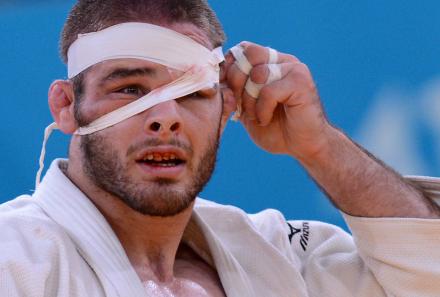
  • Travis Stevens' semifinal match against Bischoff was ridiculous...  He got a small mouse right at the beginning, so they wrapped tape around his head a few times, partially obscuring his vision.  Then he got a scratch on the bridge of his nose, so they wrapped another piece of tape around his head a few more times, further obscuring his vision out of that left eye.  And now he looks like a mummy.  Later in the match, I think he got poked in his one good eye.
    • That match got testy (teste?), too.  I've never seen a ref demand that players shake hands in the middle of a match.
  • Of course, this wasn't the worst tape job of the day: Ugo Legrande had a strip going in between his nose and his lip. Ugo Legrand of France reacts to losing to Hussein Hafiz of Egypt in the men's -73kg Judo
  • American fans really showed up in this games.  There seem to a been a ton of fans there.
  • What's even better, the American team really showed up this year. Our first gold ever, a bronze, and two semifinal appearances. That's phenomenal.  A lot of respect is due to our athletes and to Coach Jimmy Pedro, Jr. for their great work over the last several years.
  • The Japanese, on the other hand, seem to be on the way down. Seven medals, with only one gold – and no golds for the men.  Of course, they had more medals than we had participants, but it's not good by their standards.
  • There were a ton of examples of bad refereeing in this Olympics, but the example that stands out most to me is this one:  Nakai of Japan was thrown for Waza Ari with only the bottom of his butt touching the mat, as he rolled over his opponent (his opponent precluding even a possibility that his back could have touched the mat).  What the hell?
  • I have grown to really hate the music that they play at the start and end of all the matches.
  • Was I just taught the wrong thing when I took my reffing class?  nine times out of 10 when there's a score change, the match is stopped and referees conference.  I thought that when there is a difference of opinion over the score, the procedure was supposed to go like this:
    • Corner judges were to signal their desired score from a seated position.
    • In the event that they both showed the same score, they would stand up to signal to the center referee that they agreed.
    • in the event that they disagreed, they would effectively average the score between their respective scores and the center ref's score, and then rise signalling that average (unless the average was the same as the center ref's original score).  
      • For example, the center ref signals an Ippon, and the two corner refs think it was a Waza Ari.  They signal Waza Ari and stand to let the center ref know that they agree.
      • The center ref signals an Ippon, one corner ref signals a Waza Ari, the other corner of signals a Yuko. The judges average their score to a Waza Ari, and stand to signal this to the ref.
      • The center ref signals a Waza Ari, one corner of signals an Ippon, and the other corner ref signals aYuko.  Since the average is a Waza Ari (the center ref's score), the corner judges drop their signals and do nothing else.
    • When the center ref sees that he's been overruled by the standing corner judges, he waves off his original score and signals the new score that the corner judges show.

1 comments

Quick Thoughts on the Olympics, Thus Far (Round 1)

I haven't watched all of the divisions, but wanted to offer some commentary on what I have seen, so far:

  • Wow... the 60 kg Frenchman Milous was really given a gift against his Georgian opponent:  Down a yuko with 30 seconds left, he was thrown for no score with only his Frenchness preventing the Ippon (the Georgian was ROBBED).  With JUST 5 SECONDS on the board, Milous destroyed the guy with an ippon.
  • Neuso SigauqueSigauque (right) from Mozambique is 27, though this dude looks like a teenager.
  • Watching this stuff without Neil Adams doing the commentary just isn't the same... I just want someone to yell "ROIGHT THE WAY OVA!" or "HE SWITCHED IT!"
  • Also, the randomly-timed advertisements on NBC.com's streaming are ANNOYING.  Couldn't they find an intern somewhere to put in queues for commercials during the "Matte" times, or - better still - after matches?!?  Also annoying is the fact that it crashed my computer several times.
  • What's up with some folks not having their country abbreviation on the back of their gis?  I saw it with Mozambique, Cambodia, and one or two others...
  • Is it just me, or are there a TON of "golden score" rounds due to nobody scoring in the regular contest time?  I have watched a number of contests where the only score was due to a second penalty in overtime.  BOOOORIIIIING.  Glad to see that all of the rule changes have made the contest so spectator-friendly and encourage such great judo!
  • Good to see that there is plenty of bad refereeing in the Olympics, and that we don't monopolize it in our local tourneys
  • The best example of bad reffing was in the 66 kg mens bracket: Ebinuma of Japan (white) vs. Jun-Ho of S. Korea (blue).  It went into sudden death, and blue was making the best effort by far until white busted blue, and was awarded a Yuko.  The replay confirmed that it was a good call - but the match kept going.  In sudden death.  Even though white had scored.  Now... to be honest, I was keeping one eye on my kids, so I am sure that I missed the part where he waived off the score, but it was very disjointed.  Anyhoo, skipping ahead to the end, time runs out, and it goes to ref decision.  All three judges raise their flags for blue (S. Korea) - and then the Japanese coach goes nuts, everyone stands there for a few minutes, and then the refs pretend like nothing had happened, and raise their flags for white.  Huh?  I found this article that explained that it was "overturned by a reviewing commission."  Huh?  Terrible.

17 comments

So How Would I Run a Tournament?

Alright... so if the IJF rules are awful, what does a good tournament look like? 

In a recent post I pondered what the underlying principles should be as I seek to create a tournament...  The very brief summary is that tournaments should foster:

  • Self-improvement
  • Self-assessment (per Gerry Lafon's comment)
  • Innovation within the Art
  • A sense of community within the Art
  • Publicity - that is, a connection with the non-Judo public
  • The core principles of Judo
So, using that as a touchstone, here is what I came up with:
    Lose the Japanese:  Let's start with what I imagine will be the most controversial.  As we want to use the tournament to help publicize the sport, we should not use a foreign language to narrate the competition. Ippon is the only thing I think we should keep in Japanese; it's part of the Judo brand, and, in any case, it will be pretty clear to the non-savvy onlooker what just happened (if not why it happened).  We should even replace "Hajime" and "Matte" with "Go" and "Stop".  It doesn't change a tiny bit about the competition itself, which is, after all, the main thing.  And I'm just talking about tournaments, here.  Feel free to keep the Japanese in classes.
    Have a Flyer: Not at all controversial, but sticking with the publicity/community outreach thing, tournament hosts should create a 1-page flyer that goes briefly over the rules, how to win, how the tournament is structured (e.g., double elimination, round robin, etc), perhaps which divisions are on which mats, and some basic info about what Judo is.  And of course, don't forget to tell mention when and where they can find a dojo.  Make the flyer succinct and interesting.  Catchy, in other words.
    No Harm, No Foul:  If it isn't unsafe, and it doesn't clearly oppose the spirit of Judo (which is a nebulous thing, I understand), keep it legal.  Weird grips?  No harm -  legal.  Head-diving?  Much greater risk of neck injury - illegal.  Leg picks and other things that involve grabbing pants/legs?  It's embarrassing that I even have to ask - legal. 
    Bring Back Dakiage - Sort of: Dakiage, if you aren't familiar, is basically "the slam."  Quinton "Rampage" Jackson used to be famous for this, as seen here (@ around 40 seconds in):   Now, obviously slamming isn't safe - there are no good breakfalls from that, and after your head hits the mat, it will often bounce into the slammer's head for a guaranteed KO.  But one of the old rules went something like "if you can get them up to shoulder level with control, you win."  I like this rule.  They got rid of it, and now have a rule where if you can make the guy on bottom break contact with the mat, then you both have to start back on your feet. The rule isn't completely useless, but does lead to silly behaviors like "escaping" an arm-bar by lifting your opponent a centimeter off the mat. So, here's what I think: 1) If you can't get your opponent higher than your knee, the action continues, because it is hard to do a ton of damage to someone from that height (I think). 2) If you can get your opponent up to shoulder height in one decisive movement (with control), you win. Because they are basically pwned at that point (for my older readers: "pwned" in this case = finished). 3) If you get past the knee, but not to the shoulder (in ONE DECISIVE MOVEMENT), you just start back from standing. Reasoning is there is a risk of being spiked on your head, but it isn't guaranteed doom like shoulder height would be. And most importantly, 4) If you actually slam or spike your opponent - even if by accident, you are thrown out. This is to encourage control. By making this change, we would a) bring back a great technique that is super-duper useful, b) eliminate some more of the garbage, by-product behaviors like exposing yourself to an arm bar in order to stand your opponent back up, and c) possibly improve the quality of people's guard
    Use Points:  So here's another controversial one.  I don't have a huge issue with the Waza-ari and Yuko frameworks (or, in my no-Japanese version, "Big Score" and "Minor Score"), but I also don't think that it really adds that much to a judo competition.  And people intuitively understand points.  So, if it isn't adding that much, and a change will make it easier to grasp, why not?  Now, I'm honestly not completely sold on the idea myself...  I need to sleep on it I guess.  Maybe we can have "Big Points" and "Minor Points"?  It still preserves the quality over quantity principle, but is spelled out more clearly for the lay-audience.
    Deflate the Referees:  Too often, Judo referees remind me of that stereotypical neighborhood association guy that just lives to fine you for your grass being .02 inches higher than regulation.  They don't so much care that you are a good neighbor, they just live to punish and show their knowledge of the rules.  Honestly, I'll bet a lot of Judo referees *are* that neighborhood association guy or gal.  It's not about the ref, it's about the Judo, so I really like the approach of Freestyle Judo (and most other contact sports), where the ref will give instructions, then warnings... then penalties, unless something is just atrocious. 
    Work to Pair Up Comparable Ranks:  I recognize that this isn't always possible, especially in smaller tourneys or with certain weight classes, but if we accept that self assessment is one of the things we want our tournament to promote, we shouldn't just have our white belt face off against two sandans before going home for the day.  There are a few things you could do to help this, for instance... 
    Get Rid of Pre-Defined Weight Classes:  I don't have anything against grouping people of similar weight, but the current system has at least two bad by-products.  1) The guy that weighs X pounds may have only 2 other guys in his division, while the guy who is 5 pounds heavier is squaring off against 20 folks, and 2) It encourages cutting weight, which is at best not healthy, and at worst bad for you or even lethal.  So that guy who is X+ 5 pounds ends up fighting folks who walk around at X+20 lbs.  So just group people by weight and/or skill level, putting the cut-offs where ever is necessary to create the most balanced/fair divisions.  And the balance you place between skill level and size may vary - you could even get rid of weight classes altogether!  Now, it may be that having no defined weight classes could actually cause worse weight-cutting, and if we find that this is the case, then go back to the old way.  But we can help prevent that by ...
    All Weigh-Ins on the Day of the Tourney:  The purpose is to discourage weight cutting, which is not a judo skill, and to get rid of the home-field advantage for the local club who can cut more weight than the out-of-towners.
    Get People as Many Matches as Practical:  You come to a judo tournament to compete against others, and it really sucks to pay $40 to spend 20 total seconds on the mat against two vastly superior opponents. "OK - then get better" I can hear you thinking.  Fair enough, but let's let the guy or gal get some more matches in.  One tourney I liked (in Lafayette, LA?) had 2 pools of 5 people each in my weight class.  The pools would play round-robin style, then the top 2 from each pool competed in double-elimination.  It was fun.  A German beat me for 1st (GERMANS!), but it was a lot of fun judo.  Don't have time for that?  You can always just set up "funsies" matches between two folks that want to compete.  Just do something.  Find a way to help your competitors get more competition.
    Lastly, Invite Everyone to Dinner: You don't have to pay - just invite people.  Make them feel welcome.  Get to know these folks.  You have to eat, right?  And heck, maybe you can cut a deal with the local Sizzler to cut you a deal on the price if you can bring them 30 hungry customers?  Or maybe if you can get RSVPs, you can cater it, to help folks get back on the road more quickly... It's a small thing, but I think it will help build the spirit of community in Judo.  That was honestly my favorite part of going to competitions back in the day - the camaraderie. 
So that's what I'm thinking.  What do you think?  What did I miss?  Where did I go too far?